Stegosaurus: The Jurassic Herbivore Built for Defense
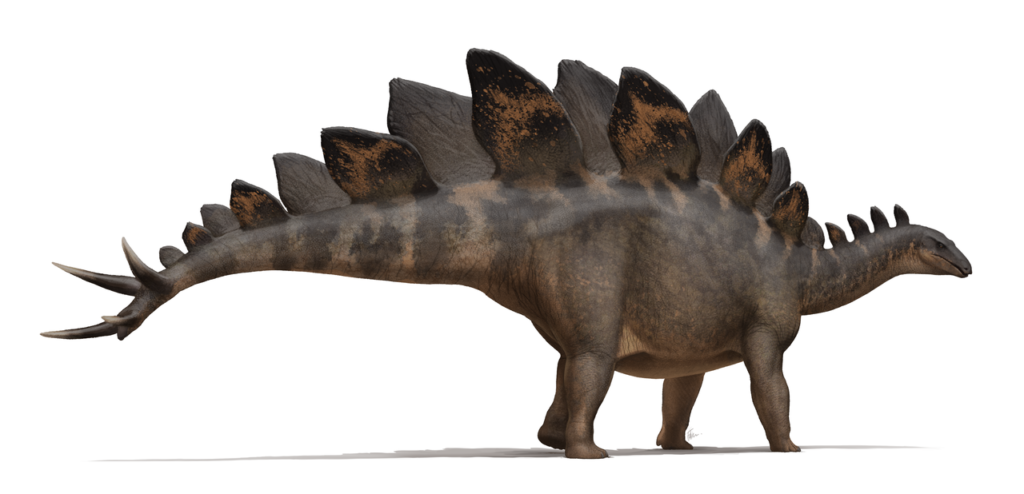
Few dinosaurs are as instantly recognizable as Stegosaurus. Its double row of tall plates and four-spiked tail have made it an icon of prehistoric life, yet the animal behind that silhouette was more complex than popular images often suggest. Living roughly 150 million years ago during the Late Jurassic, Stegosaurus was a large plant-eater that combined an unusual body plan with an effective set of defensive tools.
A Giant with an Unusual Shape
Stegosaurus had a small head, a long body, powerful hind limbs, and shorter forelimbs that held its torso close to the ground. This posture suited a browser that fed mainly on vegetation near the forest floor. Its narrow skull and tooth arrangement indicate that it was not built to chew tough, fibrous plants in the same way as later, more efficient herbivorous dinosaurs. Instead, it likely selected softer leaves, shoots, and other available vegetation.
The contrast between its enormous body and famously small brain has often encouraged exaggerated claims about its intelligence. A small brain does not mean the animal was helpless or incapable of effective behavior. Survival depended on senses, movement, defensive coordination, and an anatomy adapted to the pressures of its environment—not on having a large brain relative to its body.
What Were the Plates For?
The plates along Stegosaurus’s back remain one of paleontology’s most debated features. They were thin, bony structures covered by skin and supplied with blood vessels, and their alternating arrangement created a dramatic visual display. Their exact function may not have been a single-purpose solution.
One possibility is display. Large plates could have helped individuals recognize members of their own species, advertise maturity, or make the animal appear larger to a potential attacker. Their shape and arrangement may also have played a role in courtship or social signaling. Another possibility is thermoregulation: blood circulating through the plates might have helped release or absorb heat under particular conditions. However, the evidence is not conclusive, and the plates may have served several functions at once.
What is clearer is that the plates were not simply passive decorations. Their size, position, and vascular structure suggest that they mattered to the animal’s biology, even if scientists cannot yet identify one definitive explanation.
The Tail That Made Predators Think Twice
Stegosaurus’s most formidable weapon was its tail. Near the tip were four long spikes, a defensive arrangement commonly known as a thagomizer. The tail could be swung with considerable force, turning the rear of the animal into a dangerous target for any predator that moved too close.
That weapon would have been especially important against large Jurassic carnivores such as Allosaurus. A predator might have tried to approach from the side or front, but a threatened Stegosaurus could pivot and keep its tail between itself and danger. Injuries preserved in fossil bones, together with the mechanics of the tail, support the idea that these spikes were capable of causing serious wounds.
The defensive strategy was not based on speed. Stegosaurus was a heavily built herbivore, and its short front limbs limited its ability to outrun a determined attacker. Its survival instead depended on deterrence: armor-like skin structures, a threatening outline, a powerful tail, and the ability to make an approach costly.
Discovery During the Bone Wars
The scientific story of Stegosaurus is tied to the intense fossil-hunting competition of the nineteenth century known as the Bone Wars. The first remains were described in the 1870s, when paleontologists were rapidly naming dinosaurs from fossils recovered in the American West. Early interpretations were understandably uncertain. The animal’s plates and tail spikes were unlike anything familiar, and some of the first reconstructions placed the plates incorrectly.
As more skeletons came to light, researchers gradually developed a clearer picture of its anatomy. The history of those discoveries also shows how scientific knowledge changes: dramatic fossils can inspire confident explanations, but later specimens and better comparisons often require those explanations to be revised.
The Myth of a Second Brain
A cavity near the hips led to a long-standing claim that Stegosaurus possessed a “second brain.” The idea became popular because the cavity appeared large compared with the animal’s actual braincase. Modern interpretations are more cautious. The space may have housed a glycogen body or other tissue associated with the spinal cord, but there is no strong evidence that it functioned as a second brain.
The myth is a useful reminder that an unusual anatomical feature does not automatically reveal its purpose. Fossils preserve shape exceptionally well, but they rarely preserve behavior or soft-tissue function directly. Scientists must combine anatomy, comparisons with living animals, biomechanics, and geological context to narrow the possibilities.
Why Did Stegosaurus Disappear?
Stegosaurus was part of a changing Jurassic ecosystem. Climate, vegetation, competition, predator pressure, and regional environmental shifts may all have influenced its fortunes. There is no single confirmed explanation for its eventual disappearance, and extinction often results from several pressures acting together rather than one dramatic event.
Its fossils nevertheless continue to answer questions about how large herbivores lived, defended themselves, and adapted to their surroundings. Every new specimen can refine the picture of its posture, movement, feeding habits, and relationships with other dinosaurs.
A Survivor Reimagined Through Fossils
Stegosaurus endures in the public imagination because its design seems almost impossible: a low-slung herbivore carrying a roof of plates and a tail armed with spikes. But its real story is even more interesting than its outline. It was not a passive giant waiting to be attacked. It was an animal shaped by the demands of the Late Jurassic, equipped with specialized structures that helped it feed, communicate, regulate its body, and discourage predators.
More than a century after its discovery, Stegosaurus still leaves important questions open. That uncertainty is not a weakness in paleontology. It is part of the process that keeps a vanished animal scientifically alive, allowing each fossil and each new interpretation to bring the Jurassic world into sharper focus.
We aim to distinguish established evidence from interpretation, identify uncertainty where it matters, and revise articles when stronger evidence changes the picture. If you spot an error or have a better source, contact support@walkingmoda.com.