The Dinosaur With a Living battering Ram
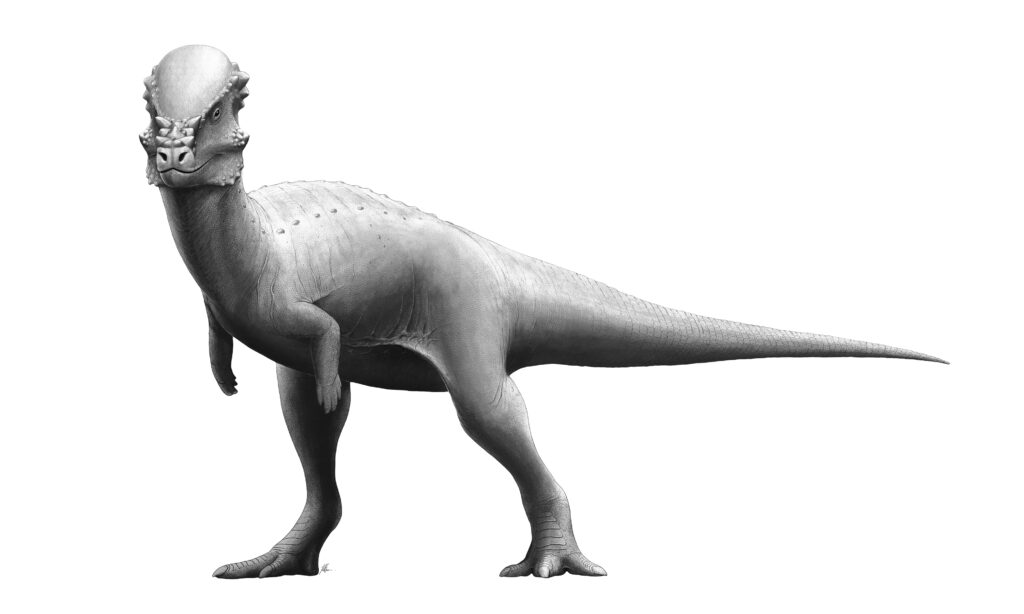
Few dinosaurs look as though evolution gave them a single assignment and pursued it to an extreme. Pachycephalosaurus was one of them. This bipedal herbivore carried a thick, rounded dome of bone on top of its skull, a structure so unusual that it has become one of the most recognizable features in the dinosaur fossil record.
Yet the dome is more than a spectacular piece of anatomy. It is a scientific puzzle. Did Pachycephalosaurus use its head as a weapon? Was the dome mainly a display structure for attracting mates and intimidating rivals? Did it help individuals recognize members of their own species? The fossils offer important clues, but they do not provide a single, simple answer.
A compact dinosaur beneath an extraordinary skull
Pachycephalosaurus lived in western North America near the end of the Cretaceous, roughly 66 million years ago. Adults were medium-sized by the standards of their ecosystem, standing on two legs and reaching an estimated 4.5 to 5 meters in length. The largest individuals may have weighed several hundred kilograms.
Its body was comparatively light and athletic next to its head. Strong hind limbs supported a bipedal gait, while a long, stiffened tail helped balance the animal as it walked, turned, or ran. The neck had to be robust enough to support the skull and, at least in theory, to handle forces generated by vigorous head movements.
The dome itself was made largely of dense, compact bone. In the largest specimens, the thickest part may have measured around 20 to 25 centimeters, although exact dimensions varied with age and individual anatomy. Bony knobs and spikes decorated the margins of the skull, giving the animal an even more dramatic profile.
Its teeth tell an important story. They were not the teeth of a predator built to tear apart large prey. The animal probably fed primarily on plant material, though some researchers have considered the possibility of an opportunistic omnivorous diet that included insects, eggs, or other small foods. The combination of modest teeth and an imposing skull is one reason its anatomy has generated so much debate.
What was the dome for?
The most famous explanation is direct head-butting. Under this hypothesis, adult individuals—often presumed to be males—lowered their heads and collided with rivals in contests over mates, territory, or social rank. Living mammals such as bighorn sheep and musk oxen demonstrate that head-to-head combat can evolve when animals need a way to compete without immediately inflicting lethal injuries.
A thick dome would offer obvious protection during such encounters. The short, sturdy neck and compact skull could have helped distribute impact, while the rounded shape might have reduced the risk of a sharp fracture. Some fossil domes show surface damage and remodeled bone, evidence that the skulls experienced injury during life. This supports the idea that the head was exposed to repeated stress.
But damage alone does not prove that animals charged one another head-on. Injuries can result from glancing blows, collisions from the side, falls, or other behavior. Biomechanical studies have also questioned whether the skull, neck, and spine were arranged to withstand the most extreme version of frontal impact. A structure can be strong enough for occasional contact without being designed for full-speed collisions.
For that reason, many paleontologists favor a broader interpretation. The dome may have been used primarily for visual display and ritualized pushing, shoving, or side-to-side contests. Rivals could compare size and condition, threaten one another, and establish dominance while limiting the danger of a catastrophic impact. The dome could also have helped individuals identify mature members of their species.
These functions are not mutually exclusive. A structure shaped by sexual selection can serve as a signal first and a weapon when confrontation escalates. Pachycephalosaurus may have displayed its dome, used it in low-speed contests, and occasionally delivered forceful blows. The fossil record does not yet allow scientists to assign a precise percentage to each behavior.
A skull that changed throughout life
One of the most revealing discoveries about pachycephalosaurids came from comparing skulls once assigned to several different dinosaurs. Dracorex hogwartsia had a relatively flat skull covered in striking spikes. Stygimoloch spinifer had a more developed dome and prominent rear horns. The mature Pachycephalosaurus skull had the thick, rounded dome that defines the genus.
Histological studies and comparisons of skull shape led researchers to propose that these forms may represent different growth stages of one animal rather than three separate species. In this interpretation, a juvenile began life with a flatter, more ornamented skull. As it matured, the spikes were remodeled and the dome became taller and thicker.
The proposal remains influential but is not beyond dispute. Fossil samples are limited, and growth-related changes can be difficult to separate from genuine differences between species. Even so, the idea carries a major lesson: fossils capture individual moments in a life cycle. A dramatic difference between two skulls does not automatically mean that two different animals produced them.
Life in the Hell Creek world
Pachycephalosaurus inhabited the Hell Creek ecosystem, a warm landscape of rivers, floodplains, forests, and coastal lowlands. The region supported an extraordinary community of late Cretaceous animals. Triceratops browsed through the vegetation with its horns and neck frill. Ankylosaurus carried armor and a powerful tail club. Edmontosaurus traveled through the landscape as a large plant-eater, while Tyrannosaurus dominated the food web as an enormous predator.
In that community, Pachycephalosaurus occupied a middle ground. It was too large to be ignored by predators, but far smaller than the heavily built herbivores that relied on horns, armor, or sheer mass. Its likely advantages included agility, a bipedal stride, and access to more wooded habitats where a giant predator would have had less room to maneuver.
The dome may have offered a last-resort defense, but avoiding a predator was probably safer than confronting one. A several-hundred-kilogram dinosaur could not realistically overpower an adult Tyrannosaurus. Speed, cover, awareness, and habitat choice would have mattered more than any single skull strike.
Evolution toward an extreme
Pachycephalosaurus belonged to the pachycephalosaurids, a group of ornithischian dinosaurs known for thickened skull roofs. Their earlier relatives in Asia had smaller bodies and much less dramatic cranial structures. Across millions of years, the lineage shows a general progression from modest thickening to increasingly elaborate domes and ornamentation.
This pattern is an example of how selection can repeatedly favor a particular feature when it provides an advantage in a specific social or ecological setting. The comparison with modern horned mammals is especially useful: mammals and dinosaurs are not closely related in this respect, yet both groups evolved reinforced head structures in contexts involving competition and display.
That does not mean evolution followed a predetermined path. It means similar problems can produce similar solutions when anatomy, behavior, and ecology make those solutions effective. In Pachycephalosaurus, the result was an unusually costly structure carried by an otherwise fairly conventional bipedal body.
The abrupt end of a successful lineage
Pachycephalosaurus survived in western North America until the end-Cretaceous mass extinction. Around 66 million years ago, an asteroid roughly 10 to 15 kilometers across struck near what is now the Yucatán Peninsula. The impact created the Chicxulub crater and triggered earthquakes, enormous waves, atmospheric heating, widespread fires, and a prolonged reduction in sunlight.
As photosynthesis declined, plants and the food webs built upon them began to collapse. A large herbivore dependent on regular access to nutritious vegetation had few ways to endure months or years of ecological disruption. Above the extinction boundary, the familiar Hell Creek giants disappear from the fossil record, leaving only their remains and the questions they continue to provoke.
What the dome still teaches us
The most honest conclusion is not that Pachycephalosaurus definitely rammed its rivals, nor that the dome was merely ornamental. The evidence points to a structure shaped by a combination of social competition, display, recognition, and possibly physical contact. Its exact behavior remains open to testing as new fossils, imaging methods, and biomechanical models become available.
That uncertainty is part of the animal’s importance. Its skull shows how much information can be preserved in bone—and how much can remain hidden. It reminds us that a fossil is not a complete biography, but a fragment of a living process. A dome that seems like a simple weapon may also record age, sex, social status, growth, and the pressures of an ancient ecosystem.
Pachycephalosaurus disappeared with the rest of the non-avian dinosaurs, but its evolutionary experiment remains visible. The rounded skull rising from the rock is the trace of a lineage that transformed a head into a signal, a shield, and perhaps a battering ram. Scientists are still working out which role mattered most. That unanswered question is precisely what keeps this remarkable dinosaur alive in the history of paleontology.
We aim to distinguish established evidence from interpretation, identify uncertainty where it matters, and revise articles when stronger evidence changes the picture. If you spot an error or have a better source, contact support@walkingmoda.com.