The Long Road to Us: A 66-Million-Year Story of Human Evolution

Humanity’s existence rests on a chain of extraordinary contingencies. One of the most important began 66 million years ago, when an asteroid struck the Yucatán Peninsula and transformed life on Earth. The impact helped end the reign of the non-avian dinosaurs and opened ecological space for mammals to diversify. From that dramatically altered world, through forests and savannas, a lineage eventually emerged that could study its own origins.
After the impact: a world of opportunity
The asteroid, estimated to have been roughly 10 to 15 kilometers across, released an immense amount of energy. Earthquakes, tsunamis, fires, and a prolonged reduction in sunlight disrupted ecosystems worldwide. Photosynthesis faltered, food webs collapsed, and about three-quarters of all species disappeared, including the non-avian dinosaurs.
Some small mammals survived in burrows, root hollows, and other sheltered places. Their flexible diets and modest energy requirements helped them endure the darkness and scarcity of the impact winter. When forests began to recover, these survivors entered a planet with many vacant ecological niches. Mammals could grow larger, adopt new diets, and develop forms suited to lives that had previously been blocked by dinosaur dominance.
Life in the trees shaped the primate body
During the Paleocene and Eocene, mammal diversity expanded rapidly. In warm, humid forests, early primate relatives took advantage of food and shelter in the canopy. Moving through branches favored abilities that would later become central to the human story: forward-facing eyes, precise depth perception, flexible fingers, and increasingly capable brains.
Three-dimensional vision helped an animal judge the distance between branches. A stronger, more versatile grip made it possible to hold onto narrow supports and reach scattered food. Remembering routes through the canopy and locating seasonal fruit rewarded better coordination and learning. These adaptations did not evolve for the purpose of producing humans; they were solutions to immediate problems in an arboreal environment. Their long-term consequence was to establish a body plan and sensory system from which later primates could develop.
The Eocene was exceptionally warm. Fossil evidence indicates that crocodiles lived in what is now the Canadian Arctic and that palm trees grew near Greenland. In these ancient forests, primates diversified and developed increasingly specialized forms. Color vision may have helped some of them identify ripe fruit among green leaves, while improved visual processing supported movement through complex branches.
Climate cooling and the rise of apes
The global cooling of the Oligocene altered the conditions that had supported earlier forest ecosystems. Tropical forests contracted toward the Equator, and many primate lineages disappeared. Those that persisted tended to show combinations of flexible behavior, broader diets, and anatomical features that helped them cope with a less predictable environment.
Among these survivors were early catarrhines, the Old World primate group that includes monkeys, apes, and humans. Fossils from Egypt’s Fayum region preserve important members of this early radiation. Over time, ape lineages became distinct from tailed monkeys. The loss of the tail was gradual, and its precise causes remain debated. It may have been related to changes in posture, locomotion, body architecture, or sexual selection. The coccyx in the human spine remains a small anatomical reminder of that vanished structure.
The Miocene was a golden age of ape diversity. More than 50 ape genera lived across Africa, Europe, and Asia, occupying environments and body sizes far more varied than those represented by living apes today. Some were agile canopy dwellers; others were exceptionally large. Most of these lineages eventually disappeared, but their diversity formed the evolutionary setting in which the human branch took shape.
Separate paths from a shared ancestor
Between roughly 8 and 6 million years ago, the lineage leading to humans diverged from the lineage leading to chimpanzees and bonobos. The split was not a single dramatic moment that can be observed directly. It was the beginning of a long separation between populations whose descendants accumulated different adaptations.
Late Miocene Africa was becoming more geographically and climatically varied. Forests contracted in some regions, dry seasons became more pronounced, and mosaics of woodland, grassland, and open areas expanded. The older idea that humans simply moved from forest into savanna is too simple to explain the evidence, but changing environments clearly created new pressures and opportunities. Different populations faced different combinations of food, terrain, predators, and climate.
Sahelanthropus tchadensis, represented by a skull from Chad dated to around 7 to 6 million years ago, is one of the oldest candidates near the beginning of the human lineage. Its relatively small brain resembles that of a chimpanzee, while the position of the opening at the base of the skull has been interpreted by some researchers as possible evidence of more upright posture. Its exact place in the family tree remains contested. That uncertainty is a normal part of science: fossils are incomplete, interpretations can differ, and conclusions are revised when new evidence appears.

Walking on two legs
Between about 4 and 2 million years ago, australopithecines made habitual bipedalism a defining feature of their way of life. They still retained important climbing abilities, but their hips, legs, ankles, and feet were adapted for sustained upright walking.
Lucy, an Australopithecus afarensis skeleton discovered in Ethiopia in 1974, provides especially compelling evidence. Her femur, hip structure, ankle, and foot anatomy show that she walked upright, while her relatively long arms and curved fingers indicate that trees remained part of her world. Fossil footprints preserved in volcanic ash at Laetoli, Tanzania, offer another direct record of early hominins walking across a landscape more than 3.5 million years ago.
Bipedalism may have offered several advantages. It freed the hands to carry food or objects, reduced the body surface exposed to intense overhead sunlight, and could be more energy-efficient than knuckle-walking over long distances. Yet it also imposed costs. The human spine is an imperfect adaptation to upright posture, and the shape of the pelvis created difficult trade-offs in childbirth. Evolution did not design a flawless machine; it modified inherited structures under competing pressures.
Tools, fire, and the expanding human niche
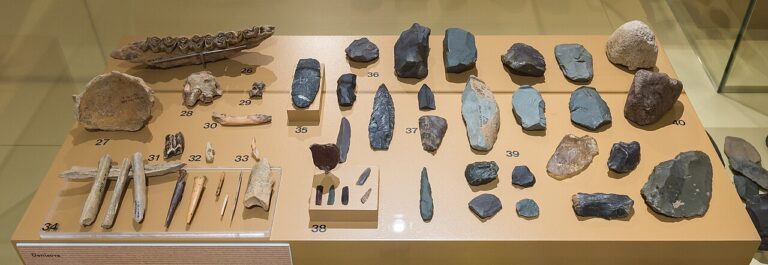
The first stone tools associated with the genus Homo belong to the Oldowan tradition. These flakes were simple, but producing them required selecting suitable stone, transporting it, striking it at a useful angle, and learning the technique through observation. The significance of early technology lies not only in the sharp edges themselves, but in the beginnings of socially transmitted knowledge.
Homo erectus later combined a more modern body shape with increasingly capable technology. Long legs and a relatively narrow torso supported efficient walking and possibly endurance travel. Acheulean hand axes, worked on both sides into deliberate shapes, suggest that toolmakers could hold a mental image of a desired object while manufacturing it.
Fire added another powerful advantage. Although the earliest evidence is debated, the long-term use of fire made food safer, softer, and more calorically accessible. Cooking reduced chewing and digestive demands, potentially allowing more energy to support the metabolically expensive human brain. This created a reinforcing cycle: better brains supported better tools and fire management; tools and cooking improved nutrition; improved nutrition supported further cognitive development.
A world with several human lineages
For much of the Pleistocene, Homo sapiens was not the only kind of human. Neanderthals lived across Europe and western Asia for hundreds of thousands of years. Their robust bodies suited cold climates, their brains were large, and their tools were sophisticated. Evidence that they cared for injured or sick group members points to meaningful social bonds.
Denisovans are known largely through ancient DNA and a small number of fossils, but their genetic legacy extends across parts of Asia and Melanesia. Some inherited variants helped later populations cope with extreme environments, including the low-oxygen conditions of the Tibetan Plateau. Other human relatives included Homo floresiensis on the island of Flores and Homo naledi in southern Africa, though important questions about their behavior and relationships remain open.
Modern humans appeared in Africa roughly 300,000 years ago. As Homo sapiens expanded, encounters with other human groups included interbreeding. Many people with ancestry outside Africa carry approximately 1 to 2.6 percent Neanderthal DNA, while some populations in Oceania and Southeast Asia carry a larger Denisovan contribution. The other human lineages did not simply vanish without leaving a trace; parts of their history continue in living genomes.
Symbolic thought and cumulative culture
Human culture became especially visible in the archaeological record between about 70,000 and 50,000 years ago. People produced paintings, carvings, ornaments, pigments, and burials that point to symbolic communication and shared meanings. A painted warty pig from Sulawesi, dated to at least 45,500 years ago, demonstrates that people were observing animals, representing them deliberately, and placing images within meaningful social settings.
The cause of this cultural acceleration is still debated. Language may have enabled people to communicate about absent, imagined, or hypothetical events with unprecedented precision. Another explanation emphasizes cumulative culture: once social networks became sufficiently connected, knowledge could build across generations instead of remaining confined to individual inventors. The power of Homo sapiens may therefore have come less from one sudden mental transformation than from the interaction of language, cooperation, teaching, memory, and population size.
These abilities supported long-distance movement. Humans reached Australia after crossing open water, settled Europe, and eventually spread throughout the Americas. Within a relatively short period, several human species became one surviving species. Competition, disease, climate shifts, small population sizes, assimilation through interbreeding, and differences in technology may all have contributed, with their importance varying by place and time.
Evolution is still happening
Human evolution did not stop when agriculture, cities, or written history began. Natural selection continues to shape populations. Adult lactose digestion evolved independently in several communities that herded cattle. Genetic variants associated with malaria resistance became more common in regions where the disease exerted strong pressure. Populations living at high altitude developed adaptations that improve tolerance of chronic low oxygen.
At the same time, medicine and technology have changed the environment in which selection operates. Treatments, surgery, public health, and social support allow many people to live healthy lives with traits that might once have sharply reduced survival. Culture has become a major part of the human environment, influencing which characteristics matter and how quickly knowledge changes.
The history written into our bodies
Our anatomy contains traces of deep time. The coccyx recalls the tailed ancestors of apes. Goosebumps are a remnant of a response that once made a thick coat appear larger to predators or rivals. Wisdom teeth reflect earlier diets and larger jaws, even though modern jaws often leave too little room for them.
These features are not mistakes in an absolute sense. They are inherited structures modified for new circumstances, carrying old functions and new compromises. The human body is a historical record as much as it is a living system.
An improbable inheritance
Our story depends on countless survivals. A small mammal had to endure the darkness after a mass extinction. Its descendants had to persist in the canopy, adapt through climate change, and pass through innumerable ecological crises. Later hominins had to navigate predators, droughts, disease, childbirth, competition, and migration. Across millions of years, every generation inherited possibilities rather than guarantees.
There was no predetermined destination. Evolution has no promise that it will produce intelligence, technology, or self-awareness. Our existence is the result of a branching history in which many alternatives disappeared. That fragility is not a reason for despair. It is a reason to recognize the value of the living world and the responsibility that comes with understanding how dependent we are on it.
We are the latest link in a lineage shaped by extinction, adaptation, cooperation, and chance. The remarkable fact is not that evolution created a perfect creature. It is that inherited bodies and accumulated knowledge allowed one species to ask where it came from—and to understand that the answer reaches back through forests, fire, ice, and a small survivor waiting underground while an altered world began again.
We aim to distinguish established evidence from interpretation, identify uncertainty where it matters, and revise articles when stronger evidence changes the picture. If you spot an error or have a better source, contact support@walkingmoda.com.