The Carboniferous Colossus: How Arthropleura Became Earth’s Largest Land Arthropod
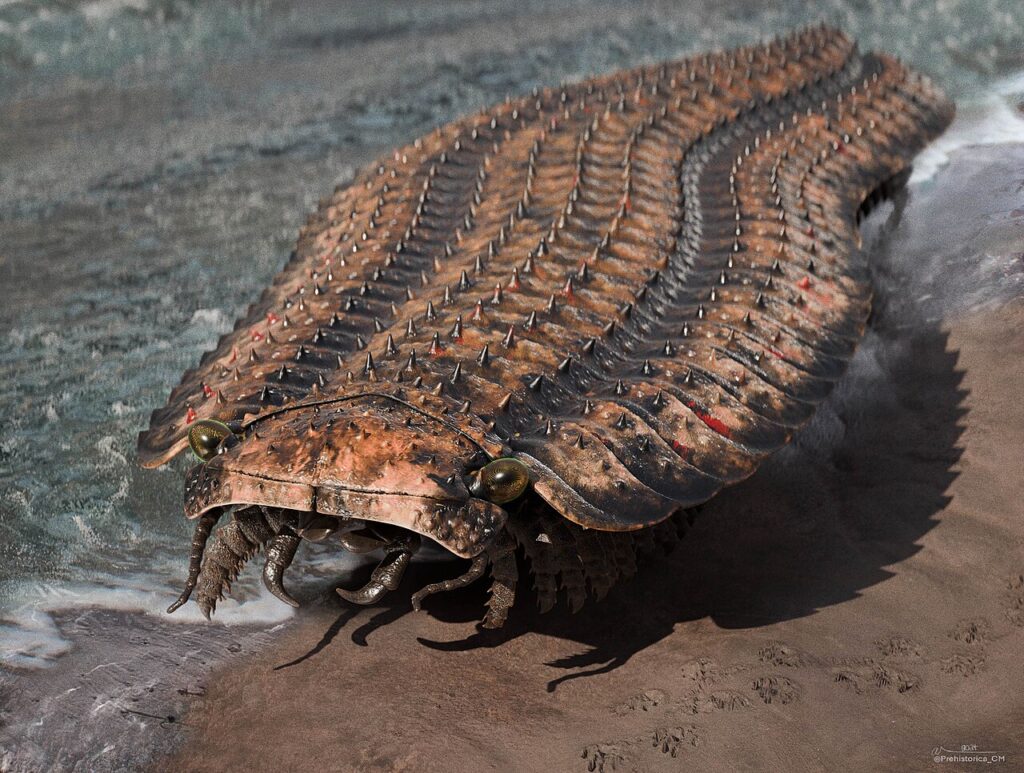
More than 300 million years ago, before birds, mammals, flowers, bees, or butterflies appeared, Earth supported a terrestrial giant unlike anything alive today. Arthropleura was a many-legged arthropod that could reach about 2.5 meters in length, making it the largest land arthropod known from the fossil record.
Its existence was made possible by a rare combination of climate, vegetation, atmospheric chemistry, and ecological opportunity. The animal was not a monster from a world of constant violence, however. Evidence suggests that this enormous creature probably spent much of its life processing plants and forest litter, quietly crossing the floor of ancient coal-forming swamps.
A giant in a world without mammals
Arthropleura lived during the Carboniferous, roughly 359 to 299 million years ago, with the most famous giant forms associated with the later part of that period. Tropical regions were dominated by swamp forests of giant lycopods, tree ferns, horsetails, and other plants that created dense, humid habitats. Some of these plants rose many meters above the ground, forming a canopy very different from modern forests.
The continents were also arranged differently. Euramerica occupied tropical latitudes, while Gondwana extended across much of the southern hemisphere. Although the planet was experiencing a late Paleozoic ice age, the tropical coal forests could remain warm and wet for long periods. Their permanently damp soils accumulated huge quantities of organic matter. Poor oxygenation, acidic water, and rapid burial slowed decomposition, allowing peat to build up and eventually become coal.
That forest floor was Arthropleura’s likely domain. Fallen trunks, roots, moss, and decomposing leaves created a maze of obstacles and a rich supply of organic material. A long, low body would have been well suited to moving through this environment, where height mattered less than stability and the ability to follow narrow passages between vegetation.
An articulated solution to a difficult engineering problem
The animal’s size becomes even more remarkable when its body plan is considered. Arthropleura belonged to the myriapods, the broader group that includes modern millipedes and centipedes. Its body was made of numerous segments, with around 30 large dorsal plates, or tergites, in mature individuals. The exact number could vary with age and among specimens.
Rather than forming one rigid shell, the plates overlapped and connected through flexible joints. This arrangement gave the animal protection while allowing it to bend around roots, logs, and uneven ground. Its many pairs of legs could distribute weight across a broad area, reducing the pressure placed on any individual limb as it crossed soft mud.
Fossil trackways suggest a deliberate, relatively slow gait. The legs appear to have moved in coordinated waves, creating a stable form of locomotion rather than a sprint. Speed was probably not essential. A fully grown animal several meters long and potentially weighing tens of kilograms would have been difficult for most predators to attack directly, and its low profile would have helped it remain balanced.
The head was comparatively small. Juvenile fossils indicate large faceted eyes and antennae that may have helped detect humidity, temperature, vibrations, and nearby food. The jaws do not provide a definitive answer about feeding habits, but their form is compatible with a plant-based or detritus-based diet.
Why were Carboniferous arthropods so large?
Arthropleura was not the only oversized arthropod of its age. The period also produced giant scorpions and flying insects such as Meganeura, a dragonfly relative with a wingspan approaching 70 centimeters. This pattern has long encouraged scientists to investigate the role of atmospheric oxygen.
Many insects and myriapods breathe through a tracheal system. Air enters through openings called spiracles and travels through branching tubes directly to tissues. In small animals, this is an efficient way to deliver oxygen. As body size increases, the distance that oxygen must travel through those tubes also increases, potentially placing a limit on growth.
Carboniferous oxygen concentrations were higher than today’s, and the resulting hyperoxic conditions may have expanded the size range available to some terrestrial arthropods. The idea elegantly connects several examples of Paleozoic gigantism. Yet oxygen was probably not the only explanation. Modern studies suggest that living insects do not necessarily operate near the absolute limit of their tracheal systems at present oxygen levels. Molting, biomechanics, development, temperature, and ecological competition also matter.
The Carboniferous terrestrial environment lacked the large, diverse vertebrate communities that later occupied many major predator and herbivore roles. Arthropods may therefore have encountered fewer competitors and fewer predators capable of challenging them. Arthropleura’s exceptional size likely resulted from several favorable conditions acting together rather than from one simple atmospheric cause.
A plant-eating giant among dangerous neighbors
The image of a 2.5-meter arthropod naturally suggests an active predator, but the available evidence points more cautiously toward herbivory or detritivory. Arthropleura may have eaten ferns, lycopod material, and the layers of leaf litter that covered the swamp floor. An omnivorous diet cannot be entirely excluded, especially because the fossil evidence is incomplete, but its jaws and ecological setting fit a primarily plant-based lifestyle.
Processing low-energy food would have required time and extensive movement through the forest. The animal may have functioned as a massive recycler, breaking down vegetation and returning nutrients to the ecosystem. Small invertebrates, including abundant Carboniferous cockroach relatives, shared the litter and decaying wood. Arthropleura could have consumed some of these animals incidentally while feeding, even if they were not its main food.
Young individuals faced greater danger than adults. They began life much smaller and had to pass through repeated growth stages, each involving a vulnerable molt. Large scorpions, primitive amphibians, and other predators could potentially threaten juveniles. Armor, increasing body size, and perhaps chemical defenses similar to those used by some modern myriapods may have offered protection, though a chemical defense in Arthropleura remains unconfirmed.
Its ecosystem was therefore not a simple hierarchy dominated by one species. It was a network of plants, detritivores, predators, aquatic animals, and early land vertebrates. The giant myriapod occupied one spectacular position within that network, but its survival still depended on the stability of the forest that supported it.
Footprints that outlasted the body
Arthropleura is known from body fragments and trackways, but its complete fossil record is surprisingly limited. Chitin decomposes readily in the warm, wet, chemically active soils where the animal lived. To preserve an exoskeleton, rapid burial in fine sediment and conditions that slowed decay were usually necessary.
Tracks had better odds. A heavy animal walking across soft mud could leave deep impressions. If the surface dried and was quickly covered by new sediment, those impressions could harden into a durable record. These trackways reveal the animal’s movement even when the body itself disappeared. They show that paleontology can reconstruct behavior from absence as well as from bones or armor.
The climate change that ended an age of giants
Arthropleura survived for tens of millions of years, but its specialized world began to break apart near the end of the Carboniferous. Around 305 million years ago, tropical forests underwent a major restructuring often associated with the Carboniferous rainforest crisis. Climate became more seasonal, with longer dry intervals and cooler conditions in regions that had once been consistently warm and wet.
Several forces contributed: the continued movement of continents, the expansion of southern ice sheets, changes in sea level, and a long decline in atmospheric carbon dioxide. The forests themselves helped drive that decline by removing carbon through photosynthesis and burying plant matter in peat. Over geological time, the productivity that built the coal swamps also helped alter the climate that sustained them.
Giant lycopod forests fragmented into smaller, isolated habitats. As wetlands contracted, the continuous forest floor on which Arthropleura depended disappeared. The emerging Permian world was generally drier and, over time, less favorable to terrestrial arthropod gigantism. Reptiles and other amniotes were also becoming more important on land, bringing new competitors and predators into ecosystems that had once been dominated by invertebrates.
The great arthropleurid lineage ended without leaving a giant descendant. Modern millipedes remain its relatives, but they represent a different evolutionary path. The experiment in extreme terrestrial arthropod size was closed by environmental change.
A direct connection to the modern world
Arthropleura’s forests did not vanish without consequence. Much of the coal formed from Carboniferous swamp vegetation was later buried, compressed, and transformed over millions of years. Coal extracted in parts of Europe and North America contains the chemically altered remains of plants that grew in the same broad era as this giant myriapod.
When that coal was burned during industrialization, ancient carbon returned to the atmosphere. The connection between the Carboniferous forest and the present is therefore physical, not merely poetic: vegetation that supported giant arthropods helped create deposits that later powered human industry.
Arthropleura lasted for roughly 45 million years, while Homo sapiens has existed for only a small fraction of that span. Its story is a reminder that no body plan is permanently successful and no climate is a fixed backdrop. Size, abundance, and dominance are opportunities granted by circumstances. When those circumstances change, even the largest land arthropod in Earth’s history can disappear, leaving behind only armor fragments and the long impressions of its passage through ancient mud.
We aim to distinguish established evidence from interpretation, identify uncertainty where it matters, and revise articles when stronger evidence changes the picture. If you spot an error or have a better source, contact support@walkingmoda.com.