Deinonychus and the Dinosaur Renaissance: How One Predator Changed Paleontology
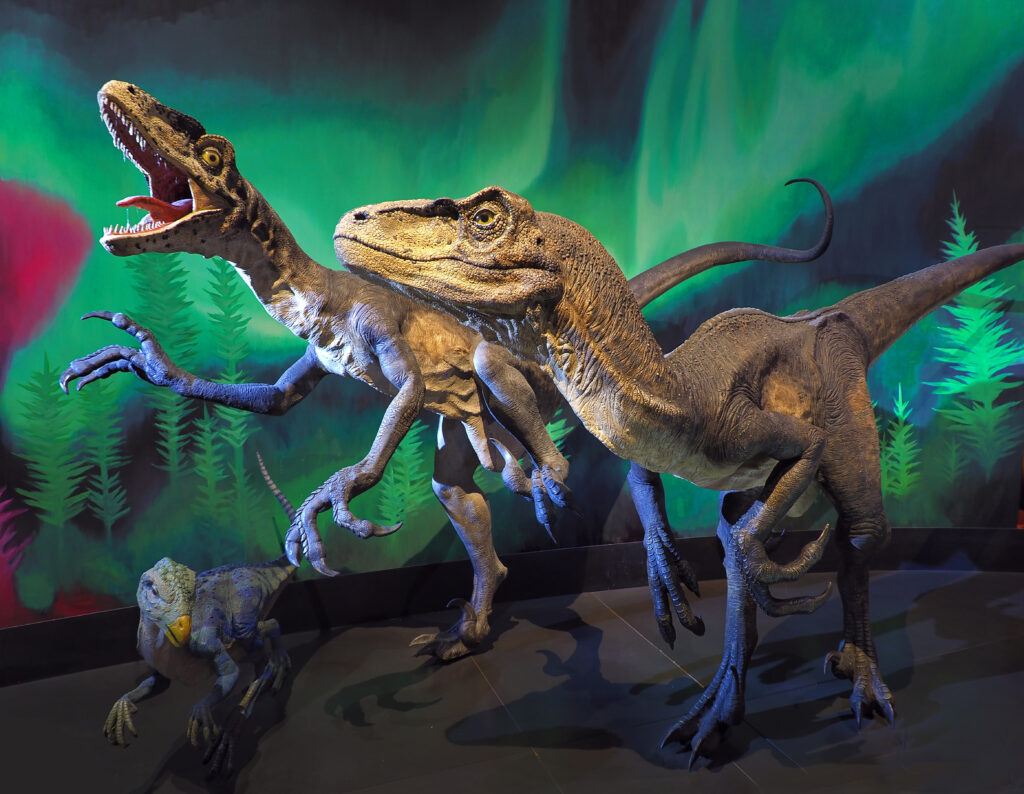
Before Deinonychus was discovered, many dinosaurs were pictured as slow, heavy animals that spent most of their lives in swamps. This small predator challenged that image. Its anatomy suggested speed, balance, coordination, and an active hunting style—and it helped scientists reconsider what dinosaurs were capable of.
Deinonychus lived during the Early Cretaceous, roughly 115 to 108 million years ago, in what is now the western United States. It was not the largest meat-eating dinosaur, but its combination of features made it exceptional. The animal measured around three metres from snout to tail, stood about a metre high at the hip, and carried a long, stiff tail that helped stabilize its body while moving.
A claw unlike any other
The most striking feature of Deinonychus was the enlarged claw on the second toe of each hind foot. This curved, sharply pointed claw could be held off the ground while the animal walked, then brought into action when it attacked or restrained prey. Its presence gave the dinosaur its name: Deinonychus means “terrible claw.”
The claw alone did not solve the mystery of how the animal hunted. Paleontologists had to study the entire skeleton. The feet, hips, arms, neck, and tail formed a connected system. Deinonychus had a relatively lightweight build, flexible joints, grasping hands, and a body plan suited to quick changes of direction. Rather than behaving like a sluggish reptile, it appeared to have been a highly active theropod.
Evidence for an active hunter
Some fossil sites preserve Deinonychus alongside the herbivorous dinosaur Tenontosaurus. These associations have often been interpreted as evidence that Deinonychus attacked animals much larger than itself, perhaps working in groups. That interpretation remains debated. Fossils found together do not automatically prove cooperative hunting; they may also reflect a predator gathering at a carcass or animals brought together by the same environmental event.
Even with that uncertainty, the fossils reveal an animal built for physical engagement. Its recurved teeth could tear flesh, while its arms and hands may have helped it hold onto struggling prey. The large toe claw may have been used to grip, slash, or pin an opponent. Researchers continue to test these possibilities with biomechanics, trackways, computer models, and comparisons with living birds and crocodilians.
The discovery that changed the picture
Deinonychus was described in 1969 by paleontologist John Ostrom after fossils were found in Montana. Ostrom’s analysis emphasized the animal’s athletic proportions and bird-like skeletal traits. He argued that the old, passive picture of dinosaurs no longer fit the evidence.
This was a turning point in dinosaur science. The discovery helped drive what became known as the dinosaur renaissance: a period when researchers began to view dinosaurs as energetic, behaviorally diverse animals rather than evolutionary failures. Dinosaur posture, metabolism, growth, movement, and social behavior all came under renewed investigation.
Why birds became part of the conversation
Deinonychus also strengthened the case that birds evolved from theropod dinosaurs. Its wishbone-like structure, three-toed feet, grasping forelimbs, hollow bones, and other details resembled features seen in birds. No single trait proves ancestry by itself, but the overall pattern is powerful when combined with fossils from other feathered theropods.
The connection does not mean Deinonychus was a direct ancestor of modern birds. It was more likely a close relative on a neighboring branch of the theropod family tree. Its importance lies in showing how many “bird-like” traits appeared among non-avian dinosaurs before true birds evolved.
Did Deinonychus have feathers?
No direct feather impressions are known from Deinonychus itself, so its exact covering cannot be stated with certainty. However, closely related dromaeosaurids—including well-preserved fossils from China—show feathers or feather-like structures. Feathers are also known across several branches of theropod dinosaurs.
For that reason, many reconstructions show Deinonychus with a feathered body and feathered arms. These feathers may have helped with display, insulation, balance, or maneuvering. They do not necessarily indicate powered flight. In dinosaurs, feathers evolved for several purposes long before flight became their defining function.
A lasting scientific legacy
Deinonychus matters not because it was the biggest or most frightening predator, but because it forced a better question: what does the anatomy actually tell us about an extinct animal? Its sickle claw drew attention, yet the broader revolution came from reading the skeleton as evidence of movement, behavior, and evolutionary relationships.
Every new fossil can revise the story. Some interpretations of Deinonychus have become more cautious, especially claims about coordinated pack hunting. Other conclusions have grown stronger, including the view that many dinosaurs were active animals and that feathers were widespread among theropods. The result is a portrait of Deinonychus that is more complex—and more interesting—than the old image of a primitive reptile.
Deinonychus helped turn dinosaurs from museum curiosities into a dynamic field of scientific research. Its legacy can be seen whenever paleontologists use bones, footprints, feathers, and living animals to reconstruct not only what an extinct creature looked like, but how it moved, hunted, and fit into its ancient ecosystem.
We aim to distinguish established evidence from interpretation, identify uncertainty where it matters, and revise articles when stronger evidence changes the picture. If you spot an error or have a better source, contact support@walkingmoda.com.