Chicxulub: How One Impact Ended the Age of Dinosaurs
Sixty-six million years ago, Earth lost roughly three-quarters of its species in one of the fastest and most consequential biological crises in the planet’s history. The event is often reduced to a single sentence—an asteroid killed the dinosaurs—but the evidence points to a more complex story. A giant impact delivered the decisive shock, while an already stressed world may have been less able to recover.
A world under pressure
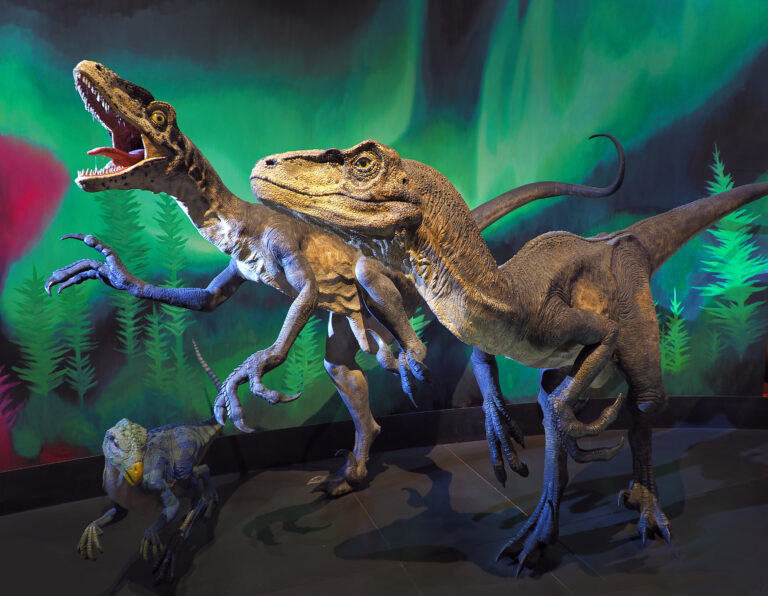
At the end of the Cretaceous, non-avian dinosaurs still dominated the land. Tyrannosaurs occupied the top of the food chain, horned dinosaurs and duck-billed herbivores supported enormous populations, and armored animals moved through forests and floodplains. Marine reptiles patrolled warm seas, while flowering plants were transforming terrestrial ecosystems.
Yet abundance did not necessarily mean resilience. Some analyses of the fossil record suggest that dinosaur diversity had begun to decline millions of years before the catastrophe, particularly among large herbivores. The interpretation remains debated: the pattern may partly reflect an uneven fossil record and regional differences. Even so, a simpler ecosystem—with fewer species able to perform overlapping ecological roles—would have been more vulnerable to a sudden disturbance.
The Deccan volcanic crisis
At roughly the same broad time, enormous eruptions were building the Deccan Traps in what is now India. The lava flows covered vast areas, but the gases released during repeated eruptive pulses may have mattered even more. Carbon dioxide contributed to warming, while sulfur dioxide could form sulfate aerosols and acid rain, disrupting photosynthesis, soils, rivers, and food webs.
These changes did not necessarily produce an immediate global collapse. Volcanism works through repeated disturbances and cumulative stress. Climate shifts, altered rainfall, and pressure on plant communities could reduce reproductive success and weaken populations over generations. Whether Deccan volcanism alone would have caused a mass extinction remains uncertain, but it likely added fragility to the late Cretaceous biosphere.
The asteroid’s final approach
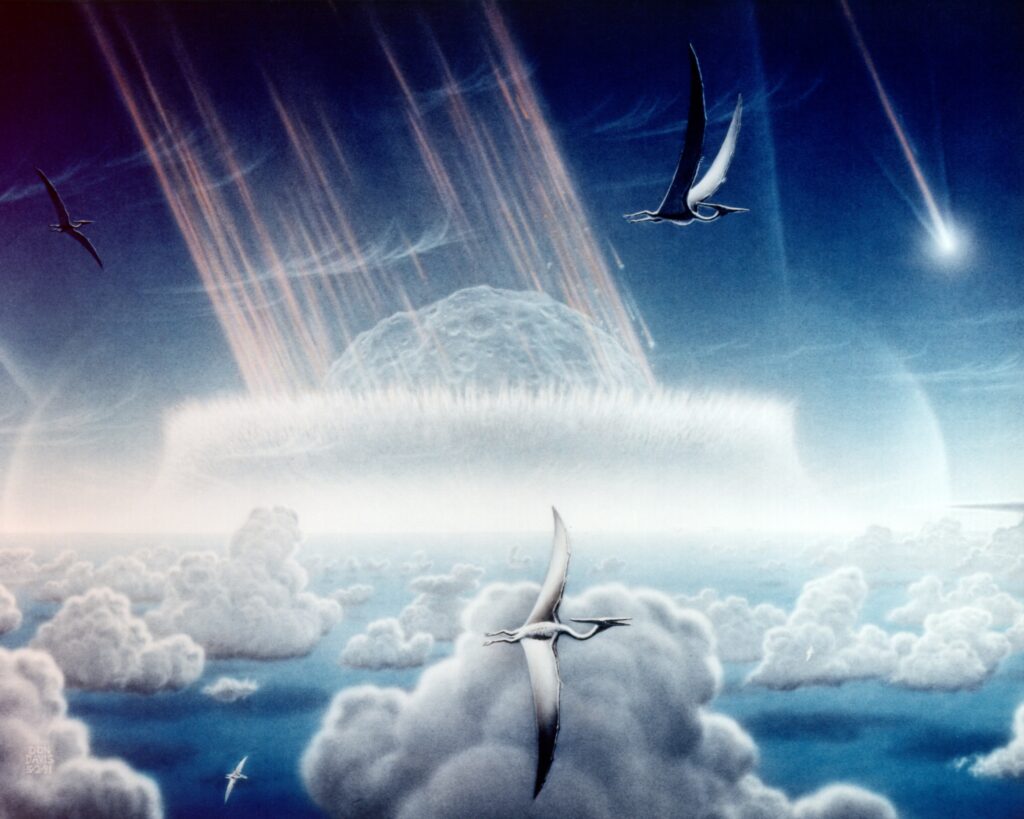
The impactor was probably about 10 to 15 kilometers wide and traveling at tens of thousands of kilometers per hour. It struck the shallow carbonate-rich platform near today’s Yucatán Peninsula. In an instant, the collision released energy on a scale comparable to many billions of tons of explosives, vaporizing rock and generating a crater about 180 kilometers across.
The angle of impact may have amplified the damage. Modeling suggests an approach of roughly 40 to 60 degrees above the horizon, a geometry capable of sending particularly large quantities of vaporized sulfur-bearing material and dust into the upper atmosphere. The result was not simply a powerful explosion at one location, but a planetary cascade.
Fire, earthquakes, and tsunamis
Near the impact site, a flash of heat and a pressure wave killed organisms almost immediately. Rock was excavated, melted, and thrown high above the atmosphere. Seismic waves crossed the planet, and enormous tsunami waves swept coastlines around the Gulf of Mexico, the Caribbean, and the North Atlantic.
Material launched into space later re-entered the atmosphere, adding intense heating in the hours after the collision. The same event then produced the opposite condition: a dark, cold world. Dust, soot, sulfate aerosols, and vaporized rock reduced incoming sunlight. Photosynthesis fell, temperatures dropped, and the surface environment became hostile to organisms dependent on a continuous supply of fresh vegetation.
The evidence in the rocks
One of the key clues is an iridium-rich layer at the boundary between the Cretaceous and Paleogene periods. Iridium is rare in Earth’s crust but more common in many extraterrestrial bodies. Researchers found an anomalous concentration in sediments from widely separated locations, suggesting that material from a large impact had been distributed around the globe.
The hypothesis gained further support when scientists identified the buried structure beneath the Yucatán region. Geophysical surveys and drilling revealed shocked, melted, and recrystallized rocks—signatures of pressures and temperatures produced by a hypervelocity impact. Together, the global iridium layer and the crater provide a powerful geological record of the event.
Why the food web collapsed
The extinction was not instantaneous for every species. Animals far from the impact zone faced a slower crisis. As sunlight weakened, plants declined. Large herbivores, which required enormous daily quantities of vegetation, were among the first to suffer. As their populations fell, large predators lost their prey. The collapse moved upward through the food web, from primary producers to herbivores and then to carnivores.
Small, flexible organisms had better odds. Mammals could shelter in burrows and survive on seeds, insects, roots, or decaying organic matter. Fungi could grow without direct sunlight, and some animals required so few calories that they could endure prolonged scarcity. Survival was not a matter of being more advanced; it often came down to body size, diet, shelter, and ecological flexibility.
What survived—and what followed
Non-avian dinosaurs disappeared, but the dinosaur lineage did not end completely. Birds are living dinosaurs, and tens of thousands of species remain today. The extinction also opened ecological space for mammals, which diversified through the following eras. Eventually, among the descendants of small surviving mammals, the lineage leading to humans emerged.
It is tempting to imagine that dinosaurs would have evolved into intelligent, human-like beings if the impact had missed Earth. Such scenarios are speculation, not established science. Evolution has no predetermined destination, and a different history could have produced countless outcomes—or none resembling the modern world.
A catastrophe shaped by chance
The Chicxulub impact was the decisive blow in the end-Cretaceous extinction, but its effects were magnified by the planet’s condition, the chemistry of the target rocks, the impact angle, and the biology of the organisms caught in the aftermath. The event demonstrates how a short-lived disturbance can permanently redirect evolution when it strikes a vulnerable system.
It also gives the distant past a present-day meaning. Earth still moves through a solar system containing objects whose paths can cross our planet. Modern planetary-defense programs seek to find and track potentially hazardous near-Earth objects before they become emergencies. Studying the ancient impact is therefore not only an effort to understand why the dinosaurs vanished. It is also part of learning how a planetary catastrophe begins, how life responds, and how much of our own existence depends on an improbable chain of events.
We aim to distinguish established evidence from interpretation, identify uncertainty where it matters, and revise articles when stronger evidence changes the picture. If you spot an error or have a better source, contact support@walkingmoda.com.