Carnotaurus: The Horned Sprinter of Late Cretaceous Patagonia
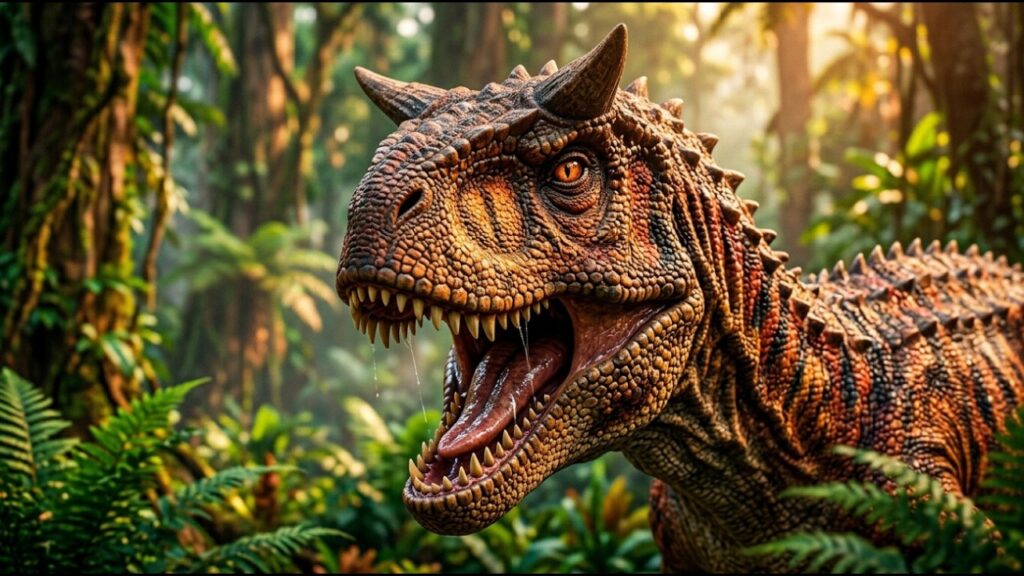
Few dinosaurs look as though they were assembled from such improbable parts as Carnotaurus sastrei. It had a deep, unusually short skull, a pair of stout horns above its eyes, extremely reduced forelimbs, and long hind legs that suggest a predator built for rapid movement. Discovered in Patagonia in 1984, its remarkably preserved skeleton gave scientists an unusually detailed look at one of the most distinctive carnivores of the Late Cretaceous.
A remarkable discovery in Patagonia
The fossil was found in Argentina’s Chubut Province by a team led by paleontologist José Fernando Bonaparte. The specimen came from the La Colonia Formation, a sequence of Late Cretaceous sediments deposited in a landscape of rivers, coastal plains, tidal flats, and lagoons. The precise age of the type specimen remains difficult to pin down, but it belongs to a world roughly 70 million years removed from the present.
The skeleton was exceptionally complete and partly articulated, although the distal portion of the tail, parts of the lower legs, and the feet were missing. The preservation of the skull, vertebral column, pelvis, and much of the limbs allowed researchers to study its proportions and biomechanics in unusual detail. It remains the single known specimen of the species, which means every conclusion must be balanced against the possibility that other individuals varied in size, anatomy, or behavior.
The horns above its eyes
Carnotaurus is named “meat-eating bull,” a reference to the horns that project upward and slightly outward from the bones above its eye sockets. These were not superficial spines. They were solid extensions of the frontal bones, integrated into the skull and possibly covered in a keratinous sheath during life.
Their exact purpose is still unresolved. One possibility is that the horns helped deliver or reinforce a blow during an attack, working with the animal’s robust neck and deep skull. Another is that they were used in contests between members of the same species, much as horns and antlers serve in some living animals. They may also have functioned primarily as visual signals of identity, maturity, or social status.
Each explanation has some biological logic, but none is conclusive. No unmistakable horn-impact marks have been identified on likely prey, and a single adult skeleton cannot reveal whether the horns differed between males and females or changed with age. The uncertainty is not a weakness in the fossil; it is a reminder that behavior rarely fossilizes.
A body built around the hind limbs
Estimates place adult Carnotaurus at approximately 7.5 to 9 meters long, with a mass commonly reconstructed in the range of about 1,300 to 2,100 kilograms. It was large, but it did not approach the mass of the giant titanosaurian herbivores that shared its environment.
Its hind limbs were the clearest expression of its evolutionary priorities. The legs were long and comparatively slender, with proportions consistent with long strides and potentially high short-duration sprinting performance. Because important parts of the type specimen’s lower legs and feet were not preserved, exact speed estimates remain uncertain. Popular figures near 55 kilometers per hour should therefore be treated as speculative rather than as a firmly measured maximum.
Even without committing to a precise number, the anatomy points to an agile large theropod. A strong pelvis, powerful tail and hip musculature, and a compact trunk would have supported efficient bipedal movement. Carnotaurus may have relied on acceleration and maneuverability to exploit opportunities that a heavier, slower predator could not.
Arms reduced almost beyond recognition
If the legs suggest specialization for movement, the arms reveal what Carnotaurus had largely abandoned. Its forelimbs were exceptionally short, with compact upper-arm and forearm bones, restricted joints, and four small fingers. They were far more reduced than the famously small arms of Tyrannosaurus rex.
The forelimbs could not have reached the mouth and probably could not have touched the ground. Their range of motion appears to have been severely limited, making grasping, holding prey, or assisting with ordinary feeding difficult to imagine. Scientists have proposed that reduced arms lowered the weight of the front of the body or accompanied the development of larger hind limbs, but these ideas remain hypotheses.
More broadly, the arms fit a pattern seen across abelisaurids, the southern-hemisphere theropod family to which Carnotaurus belonged. In this group, the head, neck, and hind limbs became increasingly important while the forelimbs diminished. Carnotaurus represents one of the most extreme examples of that trend.
Predator of an isolated southern continent
Late Cretaceous South America was not simply a smaller version of the ecosystems of North America. It had been relatively isolated for tens of millions of years, creating a separate evolutionary arena. Abelisaurids evolved across parts of the former Gondwanan world, including South America, Africa, Madagascar, and India, and developed a recognizable combination of deep skulls, strong necks, reduced arms, and robust hind limbs.
Carnotaurus pushed that body plan to an extreme. Its short, broad head differed from the long skulls of many northern large theropods, while its legs suggest a stronger emphasis on rapid terrestrial locomotion. Its probable prey included smaller dinosaurs and perhaps young, injured, or otherwise vulnerable titanosaurs. There is no direct fossil record of a Carnotaurus hunt, so the exact diet and hunting method remain open questions.
How might it have hunted?
Biomechanics allows several possibilities without proving any single scene. Carnotaurus may have used speed to close distance across open ground and then delivered quick bites to vulnerable parts of a prey animal. Its jaws appear better suited to rapid opening and closing than to the prolonged bone-crushing power associated with some other large theropods.
A second possibility is a short ambush followed by a burst of acceleration. Powerful tail and thigh muscles could have produced intense movement over a limited distance. The horns and heavily muscled neck have also inspired the idea that the animal could shove or strike at close range, destabilizing prey before biting. However, a routine high-speed collision is not established by the fossil evidence, and the impact hypothesis should be regarded as speculative.
The most defensible conclusion is broader: Carnotaurus combined a fast, highly specialized bipedal body with a skull-and-neck attack system unlike that of many better-known giant theropods. Evolution had not produced one universal design for a large predator. It had produced a design suited to a particular landscape and its particular opportunities.
Skin preserved in stone
The discovery is even more valuable because natural impressions of skin survived in several areas of the body. These impressions show a mosaic of small, non-overlapping polygonal scales, with larger conical bumps scattered especially along the sides of the trunk. The pattern gives Carnotaurus a rougher appearance than many older artistic reconstructions suggested.
No filamentous covering has been documented in the preserved regions, which indicates that those areas were scaled. It does not prove that every part of the animal’s body had identical skin. Soft-tissue preservation requires unusual conditions, including rapid burial in fine sediment and limited disturbance before the impressions could be retained in rock.
An evolutionary experiment with no modern equivalent
Carnotaurus was not an evolutionary mistake. Its horns, deep skull, tiny arms, strong neck, and fast-looking legs formed a coherent package, even though the package appears strange when judged against familiar northern dinosaurs. Isolation gave South American predators room to explore different solutions to the same basic problem: how to find and subdue food in a world dominated by large herbivores.
The species disappeared with the other non-avian dinosaurs by the end of the Cretaceous, around 66 million years ago. It left no direct descendant carrying its full combination of horns, vestigial arms, and specialized proportions. What remains is one extraordinary skeleton and a set of questions that science cannot yet answer completely—especially the most obvious one: what, exactly, were those horns for?
We aim to distinguish established evidence from interpretation, identify uncertainty where it matters, and revise articles when stronger evidence changes the picture. If you spot an error or have a better source, contact support@walkingmoda.com.