Smilodon: The Ice Age Predator Built for the Perfect Kill
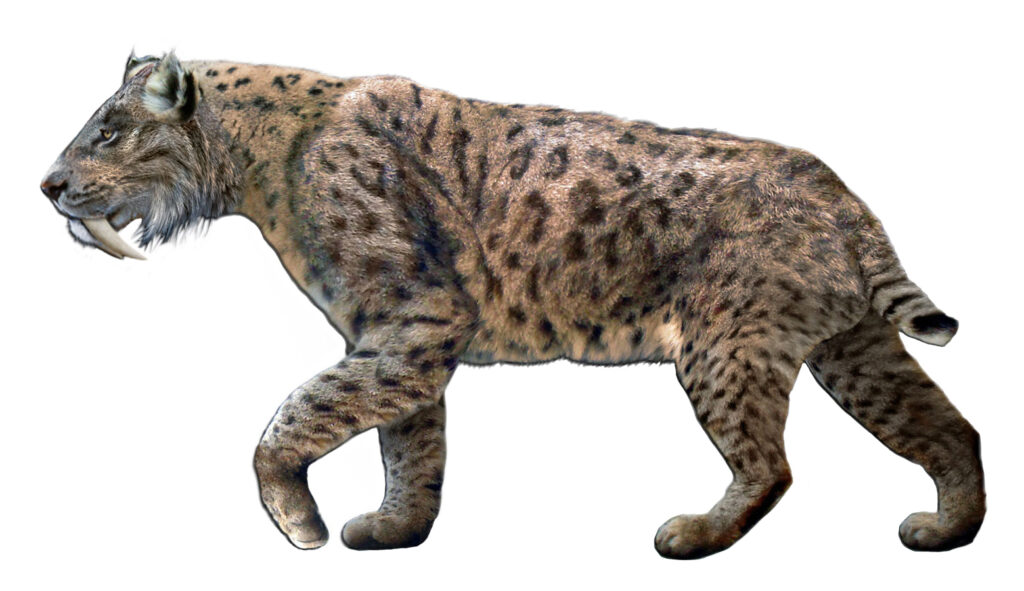
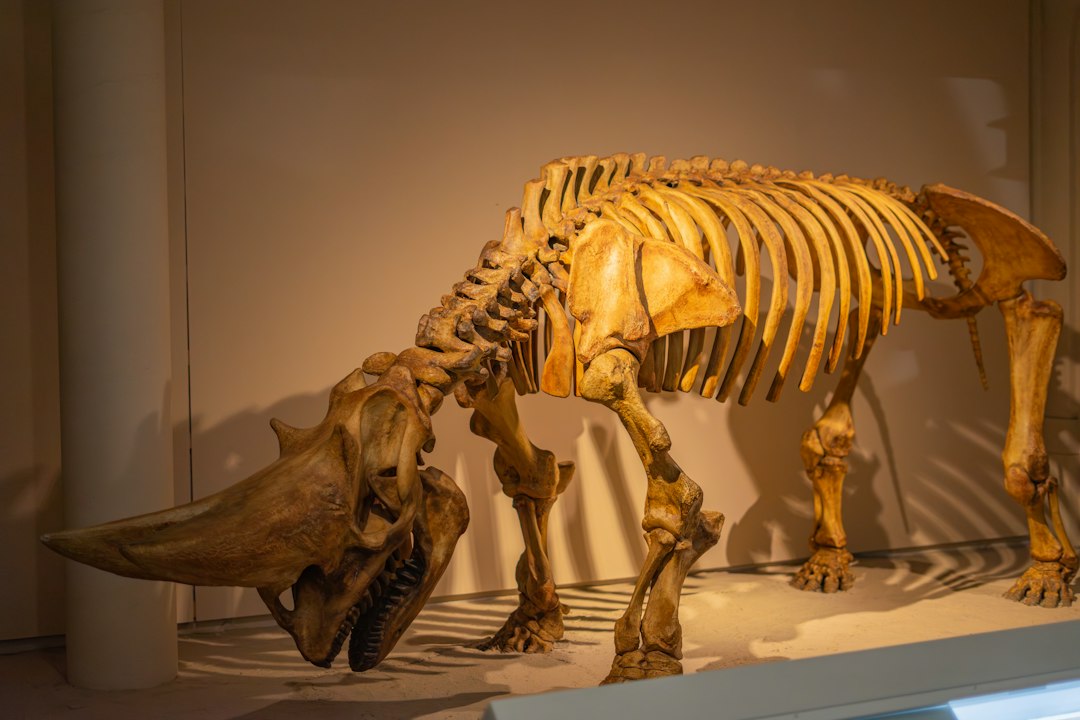
Picture a conifer forest in Ice Age California. Beyond the flicker of a fire, a massive cat waits in the darkness. It is low to the ground, heavily muscled, and almost impossible to read at a distance. When it opens its mouth, two long canines catch the light. This is Smilodon, the saber-toothed cat, and its fearsome reputation rests on much more than a pair of spectacular teeth.
A cat designed around a single opportunity
Smilodon lived in the Pleistocene, a time when North and South America supported a remarkable variety of large mammals. Depending on the species, these cats ranged from relatively compact animals to powerful predators weighing roughly 220 to 280 kilograms. The best-known North American form, Smilodon fatalis, inhabited environments that included woodlands, grasslands, and the margins of wetlands.
Its body plan was unusual among large cats. Smilodon had a relatively short back, a low center of gravity, extremely robust forelimbs, and a neck built to control struggling prey. It was not shaped like a long-distance pursuit predator. Instead, its anatomy points toward ambush: approach close, explode forward, pin the victim, and deliver one carefully placed bite.
The famous canines were precision instruments
The upper canines of Smilodon could reach approximately 28 centimeters in the largest individuals. They were laterally flattened and finely serrated, more like elongated blades than the conical teeth of a modern lion. Their edges were suited to slicing soft tissue, especially in vulnerable areas of the neck.
Those teeth were also fragile compared with ordinary feline canines. A saber-toothed cat could not simply bite down on bone or wrestle carelessly with a large animal. A misplaced strike, a sudden twist by the prey, or contact with a hard vertebra could damage the weapon on which its hunting strategy depended. The apparent excess of Smilodon’s teeth therefore concealed a strict limitation: the killing bite had to be accurate.
To use such long canines, Smilodon needed an extraordinary gape. Reconstructions suggest that the jaws could open to around 120 degrees, far beyond the normal opening of a living lion. This wide angle allowed the canines to pass around the thick hide and muscles of a large herbivore’s neck without being obstructed by the lower jaw or lips.
Why brute force was not the whole story
The popular image of Smilodon is a super-sized lion with an even stronger bite. Biomechanical studies suggest a more complicated picture. Its bite force was likely lower than that of comparably sized modern big cats when measured in the same way. That does not make Smilodon ineffective. It means that the animal shifted much of the work from crushing power to body control and cutting mechanics.
Its forelimbs were exceptionally strong. Muscle attachment scars on the bones indicate powerful shoulders, elbows, and wrists capable of pulling a large animal off balance. The cat could use its front legs to hold prey down while its hind legs braced against the ground. Once movement had been restricted, the neck could be flexed forward and the jaws opened for the decisive downward strike.
This sequence explains why Smilodon was likely cautious about the final bite. The first impact was not necessarily intended to kill. It was intended to immobilize. A large herbivore could still kick, gore, or crush a predator even after being brought down. By pinning the victim before exposing its canines, Smilodon reduced the chance that a struggle would turn its specialized equipment against it.
What did it hunt?
The Pleistocene offered prey that matched this strategy. In the Americas, Smilodon shared its world with bison, horses, camels, ground sloths, young mammoths, mastodons, and other large herbivores. The exact diet varied by species and region, but the robust skeleton and powerful front end strongly suggest a preference for substantial prey that could be attacked from close range.
Smilodon was poorly suited to chasing small, agile animals over open ground. Its build favored strength over endurance and control over speed. A deer-sized animal could turn quickly, flee through uneven terrain, or force a dangerous collision with the ground. The cat’s specialized body made sense when enormous herbivores were common, but specialization always carries a cost: success depends on the continued availability of the conditions that produced it.
Clues preserved in asphalt
The La Brea tar pits in California have preserved thousands of remains of Smilodon fatalis. The deposits are more than a collection of dramatic fossils. They are a record of repeated ecological accidents and opportunities. Large herbivores became trapped in sticky asphalt, and predators were drawn toward the struggling animals. Some cats became trapped as they attempted to feed, leaving behind bones that reveal both the abundance of Smilodon and the hazards surrounding its food.
Many fossils show healed injuries. Such damage suggests that Smilodons sometimes survived broken bones, damaged joints, and other serious trauma. It also raises questions about their social lives. An injured predator might have struggled to hunt, yet some individuals lived long enough for major wounds to heal. Researchers continue to debate whether this reflects cooperative care, access to scavenged food, or simply the resilience of an animal living in a dangerous environment.
Modern computed tomography has added another layer of evidence. Researchers can examine the internal structure of fossil bones and jaws without destroying them. Three-dimensional models reveal the spaces occupied by muscles, the thickness of the skull, and the mechanical stresses that different bites would have produced. Each scan turns a dramatic skeleton into a testable biological hypothesis.
The end of a highly specialized dynasty
Smilodon survived for millions of years, but it disappeared near the end of the Pleistocene, roughly 10,000 to 12,000 years ago. Its extinction occurred during a period of rapid environmental change. The climate warmed, habitats shifted, and many of the large mammals on which specialized predators depended declined or vanished.
Human expansion added another pressure. Hunting, landscape alteration, and competition may have reduced already stressed populations, although the relative importance of each factor remains an active subject of research. Extinction rarely has a single simple cause. For a predator built to subdue large prey, however, the loss of those prey would have been especially damaging.
Smilodon’s disappearance illustrates an important evolutionary principle. Natural selection can produce an extraordinary fit between an animal and its environment, but that fit is not permanent protection. The same anatomy that made Smilodon superb at ambushing large herbivores left it with few alternatives when those herbivores became scarce. Its greatest strength became a constraint.
A more accurate legacy
Smilodon was neither a clumsy monster nor an invincible version of a modern lion. It was a specialized predator whose short, powerful body, immense forelimbs, flexible jaws, and blade-like canines worked together as a precise hunting system. The cat did not need the strongest bite in the Americas. It needed the right position, the right prey, and one accurate strike.
That combination made Smilodon one of the most distinctive predators ever to inhabit the continent. Its fossils preserve the outline of an animal that mastered its Ice Age world—and also show how quickly mastery can become vulnerability when the world changes.
We aim to distinguish established evidence from interpretation, identify uncertainty where it matters, and revise articles when stronger evidence changes the picture. If you spot an error or have a better source, contact support@walkingmoda.com.