A World Where Dinosaurs Never Faced the Asteroid

Sixty-six million years ago, a difference in an asteroid’s trajectory may have separated one history of life from another. Had the impactor missed Earth—or arrived at a different angle or location—the planet would not have remained a frozen snapshot of the Late Cretaceous. It would have continued changing under the influence of cooling climates, shifting continents, volcanism, competition, and evolution.
The result would probably not have been a simple dinosaur paradise. It would have been a moving evolutionary world in which dinosaurs, early birds, marine reptiles, mammals, and countless other organisms continued to respond to new pressures. Some familiar lineages might have disappeared anyway. Others could have diversified into forms unlike anything alive today.
The Late Cretaceous Was Not an Evolutionary Dead End
Popular images often portray dinosaurs at the end of the Cretaceous as a declining group awaiting an inevitable extinction. The fossil evidence suggests a more complicated picture. Late Cretaceous ecosystems contained enormous functional diversity, with predators, herd-forming herbivores, armored animals, horned dinosaurs, dome-headed competitors, climbers, swimmers, and feathered maniraptorans occupying different ecological roles.
Had the asteroid missed, these animals would still have faced ordinary evolutionary pressures. Populations would have split as continents drifted apart. Sexual selection could have exaggerated horns, crests, feathers, and other display structures. Predators and prey would have continued their arms race. Climate change would have altered vegetation and migration routes. The future would have belonged not necessarily to the largest dinosaurs, but to lineages capable of adjusting to changing conditions.
Duck-billed dinosaurs, for example, already possessed sophisticated social and acoustic possibilities. Some had elaborate cranial structures that may have helped produce low-frequency calls capable of traveling through forests and across open landscapes. Over millions of years, such communication systems might have become more specialized as group living and predator detection placed new demands on their societies.
Horned dinosaurs also had room for evolutionary experimentation. Their frills and horns varied considerably, and some of that variation may have been shaped by mate choice, recognition, or social competition. If isolated populations continued to diverge, these visual signals could have helped generate new species across a world increasingly divided by geography.
Which Dinosaurs Had the Greatest Future Potential?
Evolution does not reward spectacle by itself. A gigantic body can dominate an ecosystem, but flexibility often matters more when conditions change. Among the most promising dinosaur lineages were the maniraptorans, including dromaeosaurids and troodontids.
Troodontids combined several traits associated with behavioral complexity: relatively large brains, forward-facing eyes, and grasping hands. Their intelligence should not be casually equated with human intelligence, but these features suggest that they were exploring a different evolutionary path from heavily armored herbivores or highly specialized superpredators.
Dromaeosaurids may also have benefited from social behavior, although evidence for coordinated hunting remains open to interpretation. Fossil sites containing multiple individuals near large prey could represent cooperation, opportunistic feeding, or another kind of group association. If sustained cooperation did evolve, communication, memory, anticipation, and individual recognition could have created pressure for more flexible cognition.
That does not mean an intelligent dinosaur would inevitably have become human-like. Evolution has produced complex cognition in crows, parrots, octopuses, cetaceans, and primates, each through different anatomical and ecological routes. A highly intelligent dinosaur might have developed an unfamiliar form of problem-solving, communication, or social organization rather than hands, language, and technology resembling our own.
A Changing Climate Would Have Rewritten the Rules
The asteroid was not the only force capable of transforming the planet. The Deccan Traps in what is now India had already begun producing immense basalt flows around the end of the Cretaceous. Their gases and aerosols affected the atmosphere and climate, demonstrating that geological change could disrupt ecosystems even without a sudden impact.
Over longer timescales, the planet would also have continued cooling from its warmer Cretaceous conditions. Tectonic movements would have raised mountains, opened and closed seaways, and rearranged habitats. These changes would have altered the distribution of forests and flowering plants, making some regions more seasonal and forcing animals to migrate, specialize, or shrink.
The largest sauropods were already close to important biomechanical and ecological limits. Their limb bones carried immense loads, and their size depended on dependable food supplies. In cooler or more seasonal regions, smaller bodies could have been advantageous because they required fewer resources and were easier to sustain through difficult periods. On islands, dwarf forms might have evolved repeatedly, as the fossil record shows in other isolated dinosaur populations.
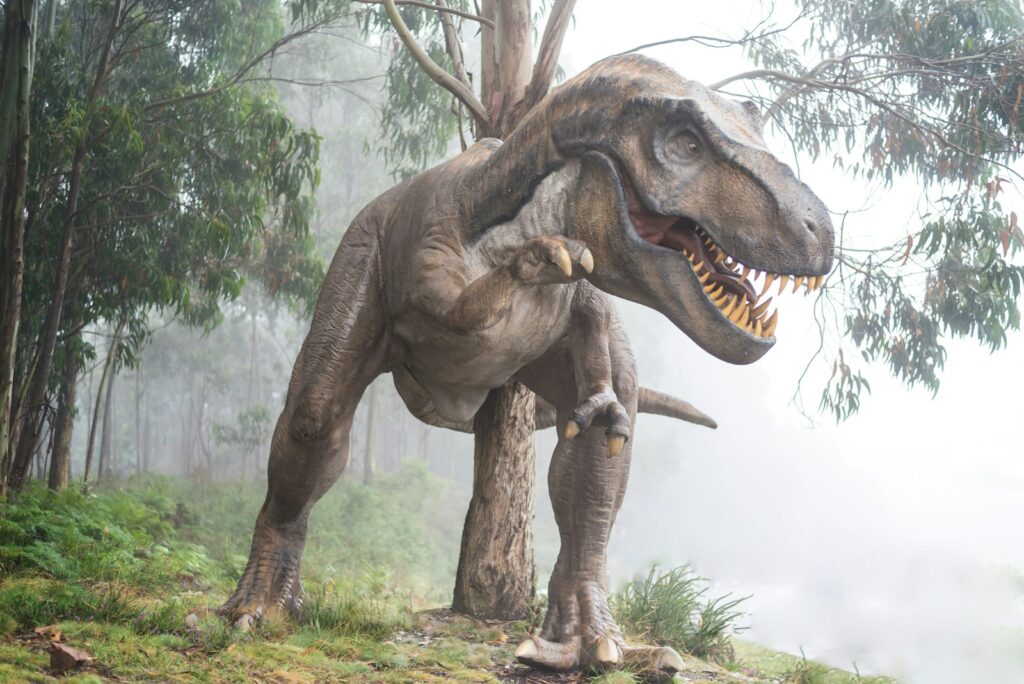
Tyrannosaurs faced a different ceiling. A bipedal predator weighing several tons already carried most of its mass over two legs. Becoming larger could have reduced mobility and made hunting less efficient. Future predatory dinosaurs might therefore have evolved toward speed, agility, sensory specialization, or cooperative hunting rather than simply increasing in size.

The Sky Would Have Belonged to Several Kinds of Flyers
The Late Cretaceous sky was not occupied by a single successful design. Enantiornithines, an ancient group of birds, were diverse and widespread. Many had teeth and claws on their wings, and they filled insect-eating, tree-climbing, fishing, and other niches. They were structurally different from the modern birds that later became dominant, but they were already conducting a major evolutionary experiment in flight.
If the mass extinction had not occurred, enantiornithines might have continued diversifying in forests, wetlands, and coastal environments. Some island populations could even have lost flight, as modern birds have done repeatedly where predators are scarce. Early modern birds would have remained part of the competition, while feathered non-avian dinosaurs might have continued developing their own approaches to aerial locomotion.
Pterosaurs would also have remained important wherever their diversity allowed. Their apparent decline near the end of the Cretaceous may partly reflect an incomplete fossil record, especially for smaller forms. The future sky could therefore have contained several overlapping experiments in flight: pterosaurs, enantiornithines, early modern birds, and feathered maniraptorans.
The boundary between “bird” and “dinosaur” would have become even harder to draw. Scientifically, birds are already living dinosaurs—the surviving branch of a much larger group. In an alternate history without the impact, many more intermediate forms might have remained alive, making the transition from ground-running dinosaur to specialized flyer visible across a far broader range of bodies and behaviors.
Reptiles Would Have Shaped the Future of the Oceans
On land, surviving dinosaurs would have occupied much of the space later exploited by mammals. In the oceans, marine reptiles would have had an equally powerful effect. Mosasaurs were already undergoing a major adaptive radiation. Some crushed hard-shelled prey, some pursued fish and cephalopods, and the largest forms hunted almost anything within reach. Plesiosaurs occupied additional marine roles, from long-necked hunters to short-necked pursuit predators.
If these reptiles had continued evolving, the early history of whales might have been very different. In actual history, the disappearance of large marine reptiles opened opportunities for terrestrial mammals moving into coastal and open-water environments. With mosasaurs and plesiosaurs still present, those opportunities would have been more difficult to enter.
Mammals might still have colonized the water. Warm-blooded physiology, nursing, and intensive parental care could have offered advantages in particular habitats. But mammalian marine forms would likely have followed different timelines and remained more limited in size or distribution. The oceans might have stayed dominated by reptiles while mammals occupied specialized gaps around coasts, estuaries, or productive seasonal waters.
That world would not necessarily have been less complex. It would simply have had different apex predators, different nutrient pathways, and different relationships between the open ocean and the continents.
Contingency and Convergence
Two broad ideas help explain why this alternate Earth is difficult to predict. One emphasizes contingency: if the history of life were restarted, random events could produce a radically different outcome. A missed asteroid might mean no humans, no elephants, and no whales in their familiar forms.
The other emphasizes convergence. Similar physical problems often produce similar solutions. Eyes have evolved repeatedly. Wings appeared independently in insects, pterosaurs, birds, and bats. Streamlined bodies evolved in sharks, ichthyosaurs, dolphins, and tuna. Even if the species were different, an ocean predator with a streamlined body, a social animal using long-distance calls, and a large-brained problem-solver might still emerge because the physics of Earth favors certain functional designs.
The most reasonable expectation lies between these views. The details would be unpredictable, but some ecological roles would likely reappear. There could have been animals capable of complex communication, fast pursuit in open water, sophisticated social behavior, and advanced manipulation. Their bodies and evolutionary histories, however, might have been completely unfamiliar.
The Dinosaurs’ Real Legacy
Dinosaurs were not an evolutionary failure waiting to be erased. They dominated terrestrial ecosystems for more than 160 million years, survived earlier environmental upheavals, and diversified across nearly every major land habitat. The asteroid ended most dinosaur lineages, but it did not eliminate the group.
Birds are living avian dinosaurs, descendants of feathered maniraptorans. Thousands of species now inhabit forests, deserts, wetlands, mountains, cities, and polar regions. Their light skeletons, feathers, warm-blooded metabolism, and extraordinary variety are part of a dinosaurian legacy that continued through the catastrophe.
In that sense, the alternate world is not the only world in which dinosaurs survived. They survived in ours too—just not in the form most people imagine. Every crow, heron, goose, and sparrow carries a small piece of a lineage that endured one of the greatest biological crises in Earth’s history.
A missed asteroid would have produced a planet without our familiar mammals and perhaps without us. But it would not have produced a static museum of dinosaurs. It would have produced another living experiment: a changing Earth filled with competition, innovation, extinction, and convergence. The forms would have been different. The evolutionary struggle would have been the same.
We aim to distinguish established evidence from interpretation, identify uncertainty where it matters, and revise articles when stronger evidence changes the picture. If you spot an error or have a better source, contact support@walkingmoda.com.